Baltimore threw a party for George Herman Ruth Jr. before he even left town. It was the weekend he packed his bags to join the Baltimore Orioles in North Carolina. The city didn’t just wave goodbye. It screamed.
Then the sky opened up.
Between Sunday and Monday, a foot of snow buried the streets. Winds tore roofs off houses. A church steeple came crashing down. It was the worst winter storm in twenty-five years. You would think a kid would stay indoors. You would be wrong.
Not even the apocalypse could stop the young pitcher. He made his way to the Keenan Hotel on Monday.
The Train Ride That Broke His Shoulder
The train left for Fayetteville on time that evening. Ruth was one of about a dozen souls aboard. The roster was a mix of hopefuls and veterans. Bill Morrisette was there. He was the losing pitcher in a St. Mary’s vs. St. Joseph’s game. Allen Russell, another Baltimore kid, boarded. Then there was Klingelhoefer. The lefty had a perfect baseball nickname: “Smoke.”
George had never been on a train before.
He stared up at a hammock-like device hanging from his berth ceiling. Old-timers knew it was for storing clothes. The Babe had no clue. One veteran told him it was a special rest for pitchers’ arms. Ruth tried to sleep with his left arm dangling in the sling. He woke up with a stiff shoulder for days.
It didn’t matter. The weather in Fayetteville was no better than Baltimore’s. It was cold. Rainy. Windy. The ground was a swamp. They couldn’t practice on the field for a week.
So they went to the local armory. They tossed balls. They played handball.
Ruth was itching to play. He wasn’t bored. He was free. The protective eyes of the Brothers were gone. He loved the hotel elevator. He begged the operator to teach him how to run it. He rode it up and down for hours.
Once, his head stuck out the doors. He accidentally engaged the motor. The car shot upward. Teammates shouted in panic. They saved him from potential decapitation.
He rose early every morning. He went to the train yards. He watched the five o’clock steam engine roll through. Then he rushed to the hotel kitchen. He was first in line for breakfast. He signed for his meals. The ball club paid.
His appetite became a joke among his mates. But the jokes were a prelude to something bigger.
The Origin of “Babe”
Rookies got hazed. It was vicious. Veterans picked on green players for anything. Or nothing at all.
The Orioles weren’t a young team. Six men on the roster had played in the majors. Five others were over thirty. They were old pros. Ruth was a kid.
The veterans roasted him relentlessly. His huge appetite kept them in stitches. They made smart comments. They called him names.
Then a coach stepped in. He told the veterans to let up.
“He’s one of Jack Dunn’s babes,” the coach said.
The message was clear. The boss thought he was special. The veterans picked up on the term. A legendary nickname was born.
George Ruth was dead. The Babe was alive.
The name wasn’t unique. William “Babe” Borton was a major league first baseman. Charles “Babe” Adams was a top National League pitcher. Danzig and Towne had also worn the moniker.
But it fit Ruth. No one else could wear it. He was big. He had childlike wonder. His appetites were thunderous. His love of life was fresh-faced and innocent. He became “the Babe” as no other ever would.
The First Professional Home Run
By March 7, the weather had turned. The Orioles had seventeen men in camp. They were short on players. They recruited a sportswriter named Roger Pippen. Pippen was supposed to be Ruth’s roommate and protector. Now he was playing center field.
They finally had a game.
Ruth, now christened with his new name, played for the Buzzards against the Sparrows. He was the shortstop and the pitcher.
He went two-for-three.
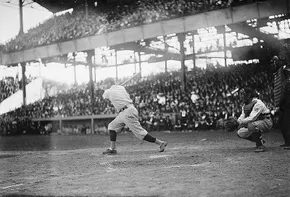
He belted a home run.
It was monumental. It was the kind of hit that gets repeated in bars and parks for a century. Fayetteville fans called it “the longest hit ever seen by Fayetteville fans.” The previous record holder was Jim Thorpe.
The ball flew deep into the right-center alley at the Cape Fear Fairgrounds. Bill Morrisette, stationed in right field, hadn’t even picked up the ball by the time Ruth crossed home plate.
Pippen measured the distance. Three hundred and fifty feet.
After just one week of professional baseball, players compared Ruth’s swing to Joe Jackson. Ruth had never seen “Shoeless Joe” play. He didn’t know him. But the mechanics spoke for themselves.
The next day, the Baltimore Sun ran a two-column headline: “Homer by Ruth Feature of Game.”
Thirty-eight years later, a man who had been the batboy for that game convinced Fayetteville to erect a marker. It honored Babe Ruth’s first professional home run. The Fairgrounds are long gone. The marker remains.
In the intrasquad games that followed, Ruth made headlines daily. He struck out batters impressively. He fielded shortstop brilliantly. He even dragged a bunt for a hit.
A March 14 article in the Sun discussed the Oriole pitchers. It said this:
Why Baltimore’s Owner Bet Big on Babe Ruth
Baltimore owner Frank “Brother” Dunn didn’t just like Babe Ruth. He saw something else entirely. Before training camp even hit its one-week mark, Dunn had already made up his mind. This kid wasn’t coming to compete for a spot. He was coming to start.
“Brother, this fellow Ruth is the greatest young ball player who ever reported to a training camp.”
The comparison Dunn threw around wasn’t just hype. He told people Ruth was destined to become a Rube Waddell. On paper, the resemblance made sense. Both were towering figures in the mound’s domain with raw, electric talent. But Waddell’s career was a cautionary tale of talent wasted by lack of control. Dunn knew the risks. He also knew Ruth had the will to survive them. The results would prove Dunn right in ways Waddell never could.
Two days later, the Baltimore Sun ran the headline that cemented the narrative: “Dunn Praises Ruth: Jack Declares He Is the Most Promising Youngster He Ever Had.”
Dunn didn’t hold back. He called Ruth “a whale with the willow.” He pointed out that some of the drives Ruth was hitting in practice would have cleared the right-field fence at Oriole Park. It wasn’t a guess. It was a projection of power that defied the era’s understanding of how a hitter should look.
“Some of the drives he is making in practice would clear the right field fence at Oriole Park.”
Think about the timeline. It had been exactly fourteen days since Ruth stepped off a train in Baltimore. He was a professional. He was being groomed as a legend before he’d even played a single official inning for the club.
The weather turned nasty. The spring training routine finally settled in. The questions shifted from “if” to “how.” How much did the Babe actually need to learn? The answers were coming fast, and they were going to change the game.