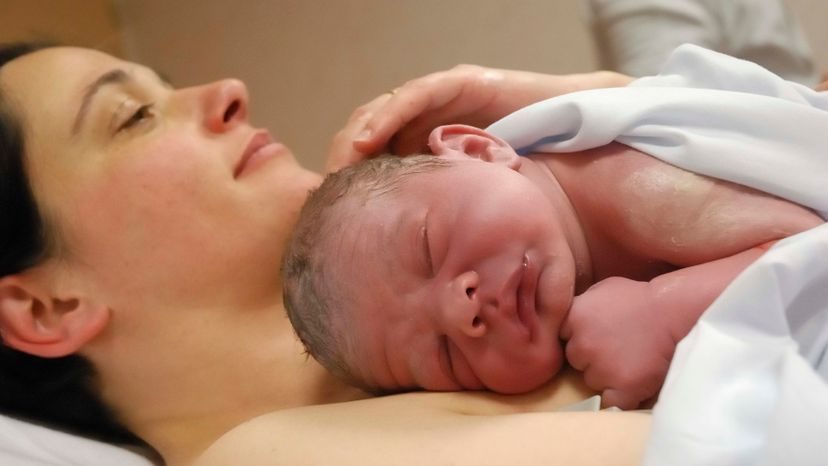
Cats do it. Dogs do it. Giraffes, lions, and lemurs all do it. It is a universal mammalian instinct to lick a newborn clean the moment it enters the world. Some humans have even been recorded doing the same, though it is rare. For the vast majority of human mothers, this behavior simply does not happen. Why?
The answer lies in a mix of evolutionary necessity, biological redundancy, and the quirks of human skin.
The Practical Purposes of Licking
Among mammals, the drive to clean a newborn is not just about hygiene. It is functional. Veterinary professors Donald M. Broom and Andrew F. Fraser outlined this in Domestic Animal Behavior and Welfare. The primary goal is temperature regulation. Amniotic fluid conducts heat away from the body. If an infant remains coated in that thick, cold fluid, it loses body heat rapidly. Licking removes the fluid. It keeps the baby warm.
The act also serves as a stimulant. It draws the baby’s attention to the mother. It signals safety.
There are other layers to this behavior. Some researchers suggest it masks the scent of birth, protecting the vulnerable infant from predators. Others point to nutrition. Consuming the placenta and amniotic fluid helps replenish the energy a mother expended during labor.
Lee Dugatkin, an evolutionary biologist at the University of Louisville, argues that licking is a multi-purpose tool. It removes surface bacteria and viruses. It helps the mother recognize the offspring through chemical signals. It creates an “early chemo-tactile link,” binding mother and child through scent and touch.
So why did humans drop this behavior?
Evolutionary Redundancy
We no longer need to. That is the blunt assessment from Dugatkin. There has been no evolutionary pressure to retain licking because humans have hands. We can clean without tongues.
Humans possess strong visual and tactile senses. We rely on sophisticated cognitive behaviors to manage care. Licking is not as useful when you can wash, dry, and hold with precision. The selection pressure for the behavior weakened as our alternative methods became more effective.
The Labor Theory
Anthropologist Ashley Montagu, who died in 1999, offered a different explanation. He wrote extensively on the significance of touch. In Touching: The Human Significance of the Skin, he theorized that human mothers don’t lick their young because human labor is unusually long.
Montagu believed that the skin stimulation provided by licking helps set in motion the proper development of organ systems. He argued that the intense stimulation of uterine contractions during a long human labor does the job instead. The physical trauma of birth acts as the necessary trigger for physiological readiness. Post-birth licking, therefore, became redundant.
Not everyone agreed. Anthropologists Donald G. Lindburg and Lester Dessez Hazell pushed back in American Anthropologist in 1972. They stated Montagu’s conclusion was unjustified. The respiratory, digestive, and genito-urinary systems of newborns do not require post-birth stimulation to function properly. They work from the start.
Furthermore, humans haven’t entirely abandoned the practice. Anthropologist William Rockhill noted in 1895 that Tibetan women in the late 1800s would lick their newborns immediately if they did not bathe them. It happened. It just isn’t the norm.
The “Cute Aggression” Impulse
Even though humans don’t lick babies clean, we still interact with their faces intensely. We kiss them. We nuzzle. We pretend to gobble them up. Scientists call this “cute aggression.”
An international team of researchers, including Johannes Frasnelli from the University of Montreal, investigated this impulse. They found it has biological roots. The smell of a newborn activates the same neurological system in mothers that is triggered by hunger. It is the system that drives humans to desire certain foods.
We find new babies delicious. We just don’t need to eat them to clean or warm them.
The distinction is subtle but important. Licking for survival is gone. The urge to consume visually or olfactorily remains. It is a neurological echo of a deeper drive.
“One would be health-related — removing any nasty creatures on the surface of the skin, such as bacteria, viruses, that sort of thing”
This biological quirk explains why we squish our faces against infant cheeks. It is not affection alone. It is a hijacked hunger response. The brain sees something adorable and smells something primal. It reacts.
Is there a downside to this? For rats, licking is key to resilience. Mother rats who lick their pups frequently produce offspring that are more exploratory and calm. Humans have traded that specific tactile link for something else. We have hands. We have faces. We have a brain that confuses cuteness with calorie-seeking.
The result is a species that cleans its young with towels and wipes, yet still feels a strange, powerful urge to bite the air near their cheekbones.