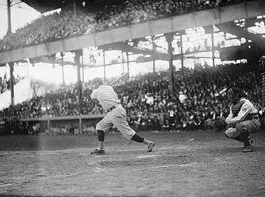
George Ruth Jr. was seven years old and already labeled “incorrigible and vicious.” That is the legal language used by his parents and a Justice of the Peace in 1902. They simply could not handle their oldest son. The result? George was committed to the St. Mary’s Industrial School for Boys.
On Friday, June 13, George Sr. took his tearful son by the hand. He delivered him to the school. The boy begged to return home. He probably vowed by all he knew as holy to mend his ways. His tears had no effect. Rowdiness and truancy had cost him. He entered the institution.
George would spend most of the next 12 years inside those walls. He only left for good when he signed a professional baseball contract.
The Structure of St. Mary’s
St. Mary’s sat a few miles outside downtown Baltimore. Six gray buildings on several acres. A large open space that fit two ballfields: The Big Yard and the Little Yard. It was surrounded by a wooden fence. The boys there called themselves “inmates.”
It was less a prison than some have said. St. Mary’s did become a true reformatory in the 1930s. But in 1902, it was different.
More than 800 students passed through. Some were committed by courts for minor offenses. Others were true delinquents. Some were orphans—this is how the “Orphaned Ruth” myth came about. Others were actually boarders whose attendance was paid for by parents.
The Xaverian Brothers made no distinction. To them, they were all the same. Boys without families. All were there to benefit from discipline, activity, education, and training.
The Brothers were strict. They were fair. Punishment was seldom corporal. The usual penalty was withholding a privilege. One of the most effective punishments was being forbidden from playing baseball. Desertions were rare. The boys stayed until they turned 21.
A Routine That Changed a Life
The core mission of the Xaverian Brothers was working with disadvantaged youth. What they taught the wild young Ruth changed him forever. Their premise was simple: idleness breeds trouble.
The boys were kept busy. A rigorous schedule seldom varied. School, training, prayer, work, and play were all parts of the minute-by-day routine.
Biographer Marshall Smelser described a typical day:
Up at six to wash and dress for Mass and breakfast. Classes from breakfast until 10 in the morning. Recess from 10 to 10:30. School or work from 10:30 to 11:30. Dinner and free time from 11:30 to 1:30. School again until 3:15.
After 3:15, there was a class in Catholic doctrine, required of Catholics only. From then until supper at six, the boys played. Small boys in the Little Yard. Boys fifteen or older in the Big Yard. After supper, they read in bed from 7:30 until lights out 45 minutes later.
Brother Matthias
The Brother who stood largest in young Ruth’s life was Brother Matthias. He was prefect of discipline and assistant to Brother Herman, director of athletics.
Matthias was a 6′ 6″ pear-shaped giant. He weighed around 250 pounds. Quietly stolid. His commanding physical presence was enough to quell schoolyard mutinies without saying a word.
Brother Matthias became teacher, mentor, coach, and friend. This bond stayed with Babe Ruth his entire life. Even after baseball fame arrived.
“It was at St. Mary’s that I met and learned to love the greatest man I’ve ever known. His name was Brother Matthias. He was the father I needed. He taught me to read and write — and he taught me the difference between right and wrong.”
George Ruth would be an “inmate” for seven and a half of the next dozen years. He was released to his parents on several occasions. Regular school still wasn’t to his liking. Before long, he’d be carted back by truant officers.
For 10 years, young Ruth could visit his family only for holidays. Nearly every weekend, his mother and sister Mamie came to visit him.
Then, around 1910, his mother died. From that point until he left the school to become a baseball player, he never had another visitor. He felt the snub keenly. “I guess I’m too ugly,” he told a friend. A totally unRuthian display of self-deprecation.
Learning a Trade
Each boy under the supervision of the Xaverian Brothers was allowed to choose a trade. The list included printer, shoemaker, electrician, carpenter, florist, and launderer.
Ruth elected to learn how to sew shirts. Most were made for the boys at the school. Some were sold to outside vendors. Each boy was paid a small amount. Ruth routinely spent all of it at the candy store. He spread his sweet earnings among the smaller kids.
George’s concern for the young lads was heartfelt. On chilly days in the yard, he was seen blowing on the hands of cold youngsters to warm them. Throughout his life, Ruth never outgrew his love for children. Perhaps because he never really outgrew being a kid himself.
The $20 Shirtmaker and the Bat
George Herman Ruth Jr. wasn’t just a kid with good hands. He had innate talent that people actually noticed early on. Specifically, his hand-eye coordination made him a shockingly good shirtmaker. Smelser noted that young George claimed he could stitch a whole shirt in under fifteen minutes. That speed impressed the biographer enough to suggest George could have pulled down $20 a week if he stuck to the needle and thread.
$20 a week sounds decent for a young worker in that era. It’s a specific number, grounded in the history of labor. But it’s also a funny footnote in baseball lore. That same $20 bill would eventually become a trivial tip Babe Ruth left for breakfast. The contrast is stark. The disciplined trade of sewing versus the chaotic, lucrative world of professional sports.
He didn’t stay with the shirts. The talent didn’t stop at fabric. George discovered a different kind of skill soon after. One that required a bat, a ball, and a lot of luck. The path to the majors wasn’t paved with thread. It started with early encounters on the diamond. The transition from shirtmaker to slugger didn’t happen overnight. It happened in the dust of minor league fields and the damp walls of St. Mary’s.
The shift in trajectory is always interesting to look back on. You have this kid, measuring cloth, counting stitches. Then suddenly he’s swinging for the fences. Literally. The skills overlapped, sure. Hand-eye coordination is the bridge between sewing and hitting. Precision matters in both. But the stakes changed. The rewards changed.
Where did he go next? The ballgame awaited. The minor leagues were the testing ground. The Hall of Fame was the distant destination. But first, there was the learning curve. The early games. The mistakes. The moments where the bat felt heavier than a pair of scissors.
It’s easy to romanticize the talent. But it was also about opportunity. And timing. George had both. He just had to stop making shirts.
“If he had stayed with his trade, he could have made as much as $20 a week.”
That’s the counterfactual that haunts baseball history. What if he sewed? The league missed a shirtmaker. We gained a legend. The math is simple, even if the path wasn’t. $20 a week versus a legacy that outlasts currency.