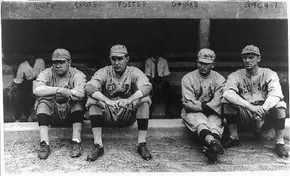
Babe Ruth in 1915 was not the cartoon character he later became. He is very thin. Muscular. His body was strengthened by the disciplined training he received at St. Mary’s Industrial School. He hasn’t gained weight yet. He was only slightly taller than the average player of his era.
His face is bright. The eyes are small and squinted. The nose is wide and flat. big lips. Journalists and fans are just beginning to understand the universal appeal of this outgoing, funny-looking kid. He enjoys the attention.
But for now, he’s just a member of the pennant-winning Boston Red Sox. The team’s regular season record was 101 wins and 50 losses. Ruth made a huge contribution in his dual role. As a hitter, he posted a .315 batting average. He hit 10 doubles. 1 or 3 triples. He hit 4 home runs in just 92 at bats. The resulting slugging percentage was 0.576. .250, above league average.
His win-loss record was also impressive. Ruth won 18 and lost eight. His ERA was 2.44. He appeared in several games off the bench and went 1-10 as a reliever. However, the Red Sox rely on him primarily as a pitcher. These appearances are a useful bonus.
The team’s offense is erratic and lacks consistent production. Outfielders Tris Speaker (.322) and Duffy Lewis (.291) are the biggest threats. Pitchers are a real strength. Ruth is tied with Rube Foster (19-8), Ernie Shore (18-8), Dutch Leonard (15-7) and Joe Wood (15-5). This is the deepest starting lineup in the American League. If the start falls, Carl Mays will be in the rotation.
Ruth is the youngest of six. At the end of the regular season, he pitched nine innings in a meaningless doubleheader. The rest of the starting lineup was rested. They saved their arm for the upcoming World Series against the Philadelphia Phillies. That workload suggests Ruth won’t get the start in the series. certainly not.
He pitched as a pinch hitter in the 9th inning of Game 3. Manager Bill Carrigan expressed considerable confidence in his hitting. Ruth ran to first base with people on base. The Red Sox lost 2-1.
he got angry. However, his mood may have improved after the Red Sox won the series in five games. This feat earned Ruth a winning share of $3,780.25. This is almost $300 more than his annual salary.
Ruth’s rise could not have come at a better time. The creation of the Federal League in 1914 and 1915 shook the sport. American League and National League owners had to pay players high wages to keep them from jumping ship. This approach applies to big stars, but it also applies to newcomers.
Some players jumped to new leagues. The ownership strategy worked in the end. The Federal League did not survive the 1916 season. The owner returned to frugal living.
This led to a wage dispute in 1915. The players fought to avoid pay cuts. Red Sox owner Joseph Lannin reduced Tris Speaker’s contract from $15,000 to $9,000. Speaker refused to sign the for spring training. Joe Wood’s salary was cut. He didn’t announce anything at all.
Boston’s players remain optimistic about the acquisition of their star player. The Red Sox are a winning team. Lannin acquired outfielder Clarence “Tilly” Walker from the Connie Mack Athletics. This was considered an insurance move, especially with Duffy Lewis injured and for spring training less than a week away.
Then came the shock. A few days later, Speaker was traded to the Cleveland Indians for $50,000 and two unproven players. Unfortunately, Sam Jones was a great pitcher and an unknown man. This is the most shocking news Boston fans have ever heard. That record wasn’t broken until a few years later when another outfielder was fired from Boston.
The trade involved the highest amount ever paid to a player. But no one except Speaker cared about the amount. The compensation was that he was a lifetime hit with a .344 batting average and was the leading hitter in the World Series. This effectively marked the end of Wood’s Boston career. He never signed with the Red Sox. The following spring, he arrived in Cleveland with friends and roommates.
The 1916 baseball season is considered Babe Ruth’s success.
Why the Red Sox pitching staff became mainstream in 1915
The depth of the 1915 Red Sox rotation explains why Ruth didn’t have to be the only primary pitcher. This team doesn’t have just one ace. These are five of them.
Rube Foster. Ernie Shore. Dutch Leonard. Joe Wood. And Babe Ruth.
Each has a winning record. All have a low ERA. Carl Mays provides important strong support. The team is now ready for a long season. It also means that Ruth can focus on his own development as a pitcher without carrying the team’s success.
How the Federal League Affects Player Salaries
The short life of the Federal League led to a temporary monopoly on the players’ labor force. The owners had to raise wages. This benefits everyone, including newcomers like Ruth.
With the collapse of the Federal League, the influence disappeared. The owners are taking cuts in wages. The most obvious victims were Tris Speaker and Joe Wood. The market has fallen drastically.
The Trade That Changed Boston
The trade of Tris Speaker to Cleveland was a pivotal moment. It’s not just the $50,000 price tag. Here’s the thing about losing a .344 hitter. It marked the end of an era in Boston.
Wood followed the Speaker to Cleveland. The Red Sox lost two stars. Ruth stayed. he is still young. Still progressing. The foundations were laid for a different kind of dominance.
Babe Ruth’s early career
To understand Ruth in 1915, you must first think of him as a pitcher. His batting record is great, but that is secondary. The Red Sox rate his arm highly. Accuracy is an added bonus.
The World Series victory confirmed the team’s strategy. Ruth earned his share. He proved his worth. But the real story is yet to come.
Read more about baseball history
- Baseball
- Minor League Baseball
- Baseball Hall of Fame