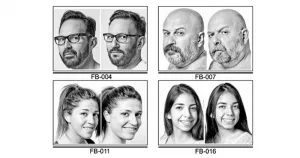
We all have a lookalike somewhere on Earth. A person who resembles you as closely as an identical twin or a reflection in a mirror. But how does this happen biologically? What connects two strangers, separated by language, culture, and thousands of miles, who share the same face?
A research team recently dug into these questions. The results were surprising.
These individuals are often called doubles or “frozen strangers.” They look like photocopies of each other despite having no genetic link. Sometimes they don’t even live in the same country. While we’ve known about these human twins for a long time, the internet era has made the phenomenon much more visible. Some celebrities’ lookalikes have actually built careers out of this resemblance.
The Science of Strangers
“Human appearance similarity has received significant attention in art and popular culture,” says biologist Manel Esteller from the University of Barcelona. But the biological link? That was largely unknown. Esteller and his team decided to fix that gap.
They leaned on a specific resource. A Canadian photographer named François Brunelle.
Brunelle has been searching the globe since 1999 for non-related double pairs. He takes photos of them. His portraits show just how startling these similarities can be. The people in these pairs don’t know each other. They come from different countries. They live thousands of kilometers apart. Yet they look like twins.
This project provided the raw material for the study. It wasn’t just about vanity or curiosity. It was about understanding human biology. The sheer randomness of the combinations challenged old assumptions. You don’t need a shared family tree to share a face.
So what is actually happening here? The study suggests that our faces are built from a limited toolkit. We have so many common facial features that the odds of two unrelated people assembling the same combination are higher than most people think. It’s not magic. It’s probability meeting biology.

Why Genetic Doppelgangers Are More Than Just Lookalikes
Facial recognition software did the heavy lifting here. Researchers used multiple programs to sift through the doubles in Fotoprojekt 16, isolating pairs whose facial features matched with the precision of identical twins. But looks can be deceiving. To understand what was actually happening beneath the skin, Manel Esteller and his team didn’t just take photos. They sequenced the DNA of every double. They dug into their genomes. They also interviewed them extensively about their health, habits, and living conditions.
The results were stark.
Even though these genetic doppelgangers share no recent ancestry, their DNA shows an unusual amount of overlap. It isn’t random noise. The matches cluster specifically in regions governing physical appearance. We are talking about the genes that dictate nose shape, cheekbones, lip structure, and mouth width. Eye color comes next. Then body metrics like height, hip circumference, and the genetic predisposition for baldness.
Non-related doppelgangers can share genetic territory as closely as siblings. Or even twins.
But the similarity doesn’t stop at the surface. Esteller noted the surprise. The genetic overlap extends to traits beyond pure aesthetics. It influences body mass. It affects height. It even shapes certain behavioral inclinations.
The team found that these doubles often mirrored each other in lifestyle factors too. Their education levels were closer than random chance would predict. Smoking habits aligned. Body weight tracked together.
“People with similar faces share many other genetically influenced physical and likely psychological traits,” the research team concluded.
This makes sense when you look at the broader picture. These people don’t know each other. Some live continents apart. Yet they share deep structural similarities. It mirrors what we see in separated twins. Twins raised apart often develop startling parallels in behavior, preferences, and even partner choice over time.
The face is just the visible tip of a much larger iceberg. The genes driving the look are likely driving the life, too. We just haven’t mapped every connection yet.