


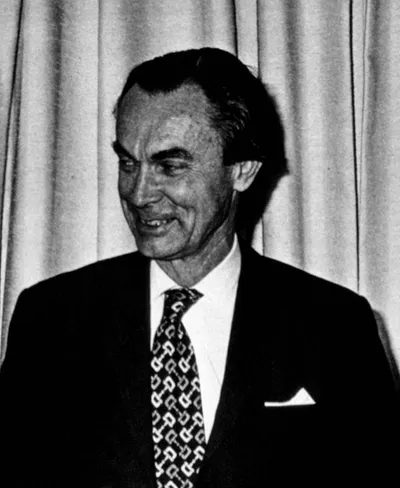
Sune K. Bergström didn’t just study body chemistry; He charted the unseen forces that govern it. He was born in Stockholm on January 10, 1916 and spent his life uncovering the secrets of the discovery of prostaglandins. By the time he died on August 15, 2004, the scientific world had already recognized his crucial role in understanding mammalian function at the molecular level.
In 1982, he shared the Nobel Prize in Physiology or Medicine with two colleagues. Bengt Ingemar Samuelsson, also from Sweden, and John Robert Vane from England. They were credited with the isolation, identification and analysis of prostaglandins. These compounds are not just biochemical footnotes. They determine blood pressure. They affect body temperature. They cause allergic reactions. Before his work, these physiological phenomena were largely a black box.
Bergström’s special contribution was fundamental. He was the first to prove that there is more than one type of prostaglandin. He determined the elemental composition of two different compounds. This difference was important. It moved the field from vague observation to precise chemical identification.
From Stockholm to the world stage
His academic career began at the Karolinska Institute in Stockholm. There he earned a double doctorate in medicine and biochemistry in 1944. Instead of staying in one place, he accepted research fellowships at Columbia University in New York and the University of Basel in Switzerland. He eventually returned to Sweden to accept a professorship in chemistry at Lund University.
In 1958, Bergström returned to the Karolinska Institute. His career there extended beyond the laboratory. In 1963, he became the dean of the Faculty of Medicine. Four years later, in 1969, he was elected rector. These were senior positions, but they did not affect his scientific achievements. In 1981, he retired from teaching. The research continued.
Leadership and Genetics Legacy
His influence extended to major global health organizations. From 1975 to 1987, he was the chairman of the Nobel Foundation. Between 1977 and 1982, he also led medical research at the World Health Organization. These positions gave him the opportunity to shape policy and finance at the international level.
The genetic and scientific legacy of the Bergström family is still prominently displayed. His son Svante Pääbo received the Nobel Prize in Physiology or Medicine in 2022. Pääbo’s work focused on hominin genomes and human evolution. The connection between father and son highlights a deep tradition of scientific research.
Bergström’s work did not solve every mystery of the human body. The door opened. When you understand how prostaglandin isolation works, you will see the mechanisms of inflammation and pain in a new light. The compounds he identified are still central to modern pharmacology. Painkillers, anti-inflammatory drugs and asthma drugs often date back to this era of discovery.
Bergström’s story is not just an award. It tells about the careful and often painstaking work in identifying the chemical structures that govern life. He stood at the interface of biochemistry and


